Tower Rush - Play and cash out in real time
Tower Rush ▷ Real Money Casino Game
This page is dedicated exclusively to the real money experience. Not the demo, not the theory, not the technical specifications you find everywhere. Here we talk about what happens when you open your wallet, deposit, and start building towers that are worth real euros.
The First Deposit — A Decision, Not an Impulse
The initial deposit deserves more thought than most players give it. It’s not a ticket to entry. It’s the boundary between free entertainment and entertainment with financial risk.
How much to deposit? The answer that works: an amount you can completely lose without it changing anything in your week. For some, it’s €10. For others, €50. For many, the right amount is lower than they would like to admit.
I deposited €25 for my first month. An amount I wouldn’t have noticed if it disappeared — the equivalent of two pizzas at a restaurant. This calibration proved crucial. When the bankroll dropped to €18 in the second week (losing streak, no bonus for twelve rounds), I didn’t feel the need to reload. The €25 was the total budget. Not an advance.
The deposit method affects perception. Credit cards and e-wallets make the transfer instant and almost invisible — a few clicks and the balance appears. Cryptos add a few minutes of waiting. Bank transfers, with their three to five days, impose a pause that acts as a natural filter against impulsive deposits.
Anatomy of a Real Money Session
A typical session lasts fifteen minutes. Twenty rounds, more or less. Here’s how it flows in practice.
Minute 0-2: calibration. The first two or three rounds serve to synchronize the timing. Minimum bet, low target (x4-x5). The goal is not to earn — it’s to get into the rhythm of the crane.
Minute 2-8: productive phase. The timing is synchronized, concentration is high. Here placements are more precise and cash-out decisions are clearer. Most of my positive rounds fall within this window.
Minute 8-12: plateau. The pace is maintained but mental freshness begins to decline imperceptibly. Placements remain good, decisions reasonable. Nothing alarming — simply the peak has passed.
Minute 12-15: closure. The timer goes off. I finish the current round and close. No "one more." No "only if this goes well." The timer goes off, the session ends.
This framework is not rigid. Some sessions produce their best moment at minute fourteen. Others fizzle out at ten. But the structure — warm-up, productive phase, plateau, disciplined closure — has consistently proven superior to "playing until I feel like it."
The Right Bet — Small, Constant, Boring
I experimented with three betting approaches during my first month. Here are the results.
Approach 1: variable bet. €0.50 after a crash, €2 after a win. The idea: capitalize on positive streaks, limit damage during negative ones. The result: chaotic. Positive streaks do not exist in a game with RNG independent for each round. I burned €7 in three sessions chasing a pattern that wasn't there.
Approach 2: increasing bet (Martingale). Double after each crash. €0.50, €1, €2, €4. In theory, the first win recovers all previous losses. In practice, five consecutive crashes led me to an €8 bet — 32% of my bankroll on a single round. I stopped the experiment before it caused irreparable damage.
Approach 3: fixed bet. €0.75 per round, always. Regardless of the previous round, current balance, mood. The result: the most stable, the most predictable, the most boring — and by far the most profitable over four weeks.
Boredom is a feature, not a flaw. The fixed bet eliminates the emotional decisions that creep in when the balance fluctuates. You don't have to decide how much to bet — it's already decided. All your mental energy goes to timing and the cash-out decision, where it really matters.
The rule of thumb: 1-2% of the bankroll per round. With €30, that means €0.30-€0.60. With €50, that means €0.50-€1. Adjust down if the bankroll decreases, up only if it grows significantly.
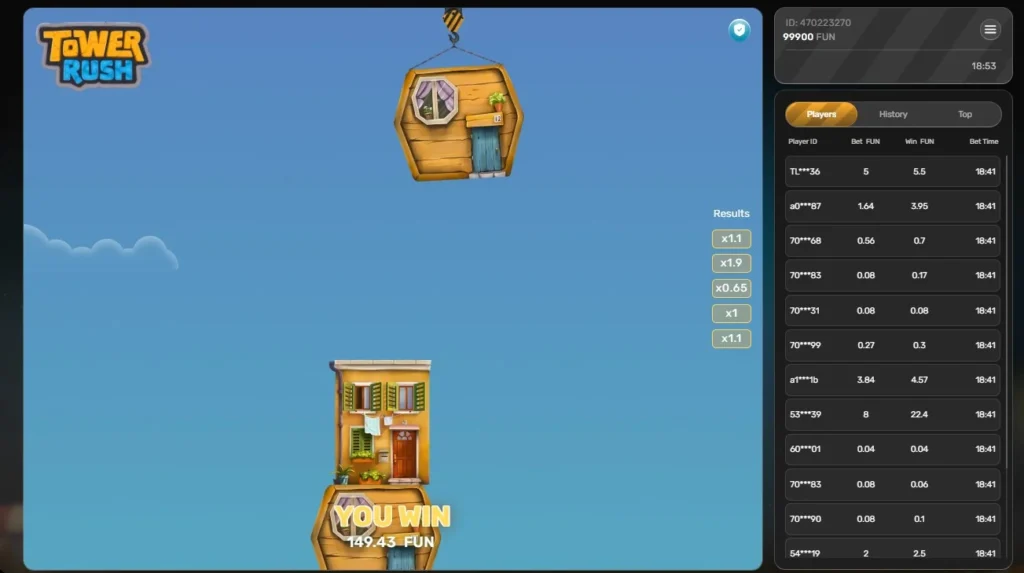
The Emotions of Real Play — Map Them to Manage Them
Real money Tower Rush generates an emotional range that the demo cannot simulate. Recognizing these emotions is the first step to preventing them from driving your decisions.
The euphoria of a high cash-out. Frozen Floor at x5, pushed to x19, cash-out of €14 on a €0.75 bet. The heart races. The immediate temptation: replicate. Bet more in the next round, push higher, chase the same rush. Resist. The next round has no memory of the previous one.
The frustration of a negative streak. Five consecutive crashes. €3.75 evaporated in three minutes. The stomach tightens. The mind calculates how much you need to recover. The finger wants to hit BUILD right away, maybe with a higher bet. Stop. Breathe. If the frustration is palpable, close the session. You'll come back tomorrow with a fresh mind and an intact bankroll.
The anxiety of the near-cash-out. You're at x11, the CASHOUT button is there, but you want x12. The block wobbles. You release it. It falls off-center. The tower collapses. The x11 you had in hand becomes zero. This scenario generates a sharp regret that contaminates subsequent rounds — you start cashing out too early "to avoid repeating the mistake." In reality, that single crash was probability, not a mistake. Your target was right. Keep it.
The boredom of disciplined play. Cashout at x7. Cashout at x7. Collapse. Cashout at x7. No bonus. Cashout at x7. This is responsible gaming in its purest form — and also in its least exciting form. Boredom is the price of consistency. Accept it or acknowledge that you are seeking excitement more than results.
Real Money Bonuses — Amplified Impact
The three in-game bonuses work mechanically the same way as the demo. The emotional and financial impact is on another planet.
Frozen Floor for real money is the moment players remember. When the multiplier freezes and you know — with mathematical certainty — that money is yours regardless of what happens next, the pressure instantly fades. Hands relax. Timing improves. Placements become more precise precisely because the fear is gone.
In my data, the average cashout after Frozen Floor for real money is x14.8 — compared to x6.1 in normal rounds. A difference of 142%. Not because Frozen Floor is magical. Because the removal of fear allows you to play at your true skill level.
Triple Build for real money generates a mix of joy and decision. Three perfect plans, multiplier jumping, and then the question: do I cash out this gift or continue? With real money, the temptation to cash out is stronger. And maybe it’s the right choice — the gift is already above expectations.
Temple Floor for real money is a small bonus that sometimes surprises. A x3 on the wheel in a x8 round means a sudden jump to x24. In demo you would have smiled. For real money, the heart skips a beat.
Bankroll Management — The Five-Week Diary
| Week | Initial balance | Final balance | Variation | Rounds played |
|---|---|---|---|---|
| 1 | €25,00 | €22,10 | -11,6% | 65 |
| 2 | €22,10 | €18,40 | -16,7% | 58 |
| 3 | €18,40 | €26,90 | +46,2% | 52 |
| 4 | €26,90 | €30,50 | +13,4% | 48 |
| 5 | €30,50 | €33,20 | +8,8% | 45 |
The first two weeks were negative. The lowest point — €18.40 — tested my discipline. The temptation to reload was real. I didn’t do it. The budget was €25, period.
The third week turned everything around. Two Frozen Floors in different sessions, a Triple Build combined with a Temple Floor. The variance that had gone against me in weeks one and two turned in my favor. The bankroll rose above the starting point.
Weeks four and five have consolidated. Modest gains, no dramatic peaks, results consistent with a disciplined fixed stake strategy.
Net result over five weeks: +€8.20 (+32.81%). But beware: the path to get there included a drop of 26.1% in the first two weeks. Without strict discipline, that drop would have triggered emotional deposits or doubled stakes — and the final result would have been very different.
Choosing Where to Play — Practical Criteria
The platform influences your real money experience more than your strategy. Five factors to consider.
RTP. Platforms at 97.1% pay out more over time than those at 96.12%. Check before depositing.
Withdrawal speed. Same-day e-wallet and crypto are the standard to look for. Slow withdrawals encourage putting funds back into play — a subtle but real behavioral trap.
License. MGA, Curacao, Gibraltar. Check in the footer. Without a license, do not deposit.
Responsible gaming limits. The casino must offer configurable tools: maximum deposit, loss limit, session timer, self-exclusion. If they are missing, the platform does not deserve your trust.
Compatible bonus. If you want to use a welcome bonus, confirm that Tower Rush is included in the eligible games with a 100% contribution.
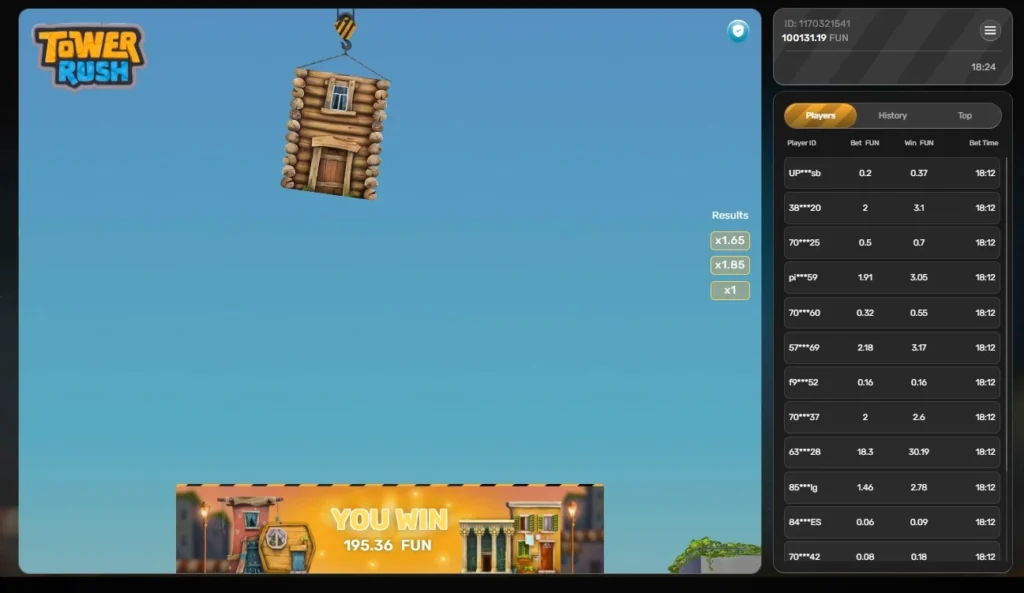
Voices from the Table — Real Money Players
Five weeks, fixed stake €0.75, target x7. Bankroll from €20 to €26. It’s not a salary — it’s proof that disciplined play works. Rounds with Frozen Floor accounted for 60.1% of the total gain.
The fixed bet was the turning point. Before, I varied between €0.50 and €3 depending on my mood. Result: bankroll wiped out in a week. With the fixed bet at €0.50, the same bankroll lasted five weeks and produced a profit.
First withdrawal: €15 on Skrill, arrived in 8 hours. Second: €20 on Bitcoin, 3 hours. Zero problems. The game pays — as long as the casino is serious.
The game is good but the first two weeks with real money were tough. The drop in bankroll made me anxious. Only discipline — and the refusal to deposit again — kept me in the game long enough to see recovery.
I use Tower Rush as my evening entertainment — fifteen minutes after dinner, three to four times a week. Initial bankroll €30, now at €38 after two months. The secret? No secret. Small bet, fixed target, short session.
Responsible Gaming — Real Money, Real Risk
With real money, responsible gaming is not a suggestion. It’s a requirement.
The money you deposit must be money you don’t need. Not “I probably won’t need it.” Not “I’ll get it back.” Money that, if it disappears, changes nothing in your daily life.
Limits should be set before the first session — when the mind is clear, not when the bankroll is down and the instinct screams to recover.
If you notice that sessions are stretching, that deposits are multiplying, that the game occupies your thoughts outside of playtime — stop. Not tomorrow. Today.
Green Phone ISS: 800-558822 (free, anonymous, professional).
Frequently Asked Questions
How much can I expect to earn?
No figure is guaranteed. The RTP of 96.12-97% implies that the house retains 3-3.88% in the long run. Positive sessions and periods are possible due to variance, but consistent profit over time is not mathematically sustainable.
What is the recommended minimum bankroll?
€20-€30 provides a reasonable base for low-stakes sessions (€0.20-€0.60). With less, the margin to absorb negative streaks becomes too thin.
What happens if my balance reaches zero?
The session ends. Do not impulsively deposit to recover. If you had a predetermined budget and stuck to it, the outcome — even if negative — is a gaming experience paid at the price agreed upon with yourself.
Are withdrawals reliable?
On licensed platforms, yes. E-wallets and crypto process in hours. Cards take days. The first withdrawal requires KYC verification.
Can I play for real money on mobile?
Yes. HTML5, no download. The experience is smooth but accuracy decreases at higher stakes. Adjust the cash-out target downwards on smartphones.
Is Tower Rush suitable for casual players?
Perfectly. Fifteen-minute sessions, bets of €0.20, three to four sessions a week. Tower Rush works just as well as an occasional pastime as it does as a regular activity.

Francesca Greco
Senior iGaming Analyst & Risk Management Expert
Vote — 4.2 out of 5
4,2/5
Tower Rush for real money is an intense, engaging, and honest experience. The building mechanics create a sense of ownership in every round that passive crash games cannot offer. The bonuses — especially Frozen Floor — amplify the best moments. The RTP is competitive and payouts on licensed platforms work.
The price of intensity: real psychological pressure, temptation to deviate from discipline, and variance that can test patience for weeks before rebalancing.
For those with the discipline to stick to a budget, a fixed bet, and a timer — Tower Rush for real money is among the best experiences in the crash game segment of 2026. For everyone else, the demo remains an excellent and completely free option.